Many cat owners face a familiar dilemma: wanting to provide an engaging, stimulating environment for an indoor cat without turning a living room into an obstacle course of bulky commercial pet gear. When indoor cats lack adequate outlets for their natural instincts, they often express their frustration through common behavioral signals such as nighttime zoomies, scratching furniture, or chewing on household items Indoor cats require varied environmental stimulation across play, food, resting perches, and sensory exploration to prevent boredom, Common signs of indoor cat boredom include nighttime zoomies, scratching furniture, and destructive chewing. Understanding these underlying needs allows owners to design apartment-friendly enrichment that respects both the feline relationship and human living spaces.
Understanding Indoor Feline Boredom and Why Traditional Gear Fails
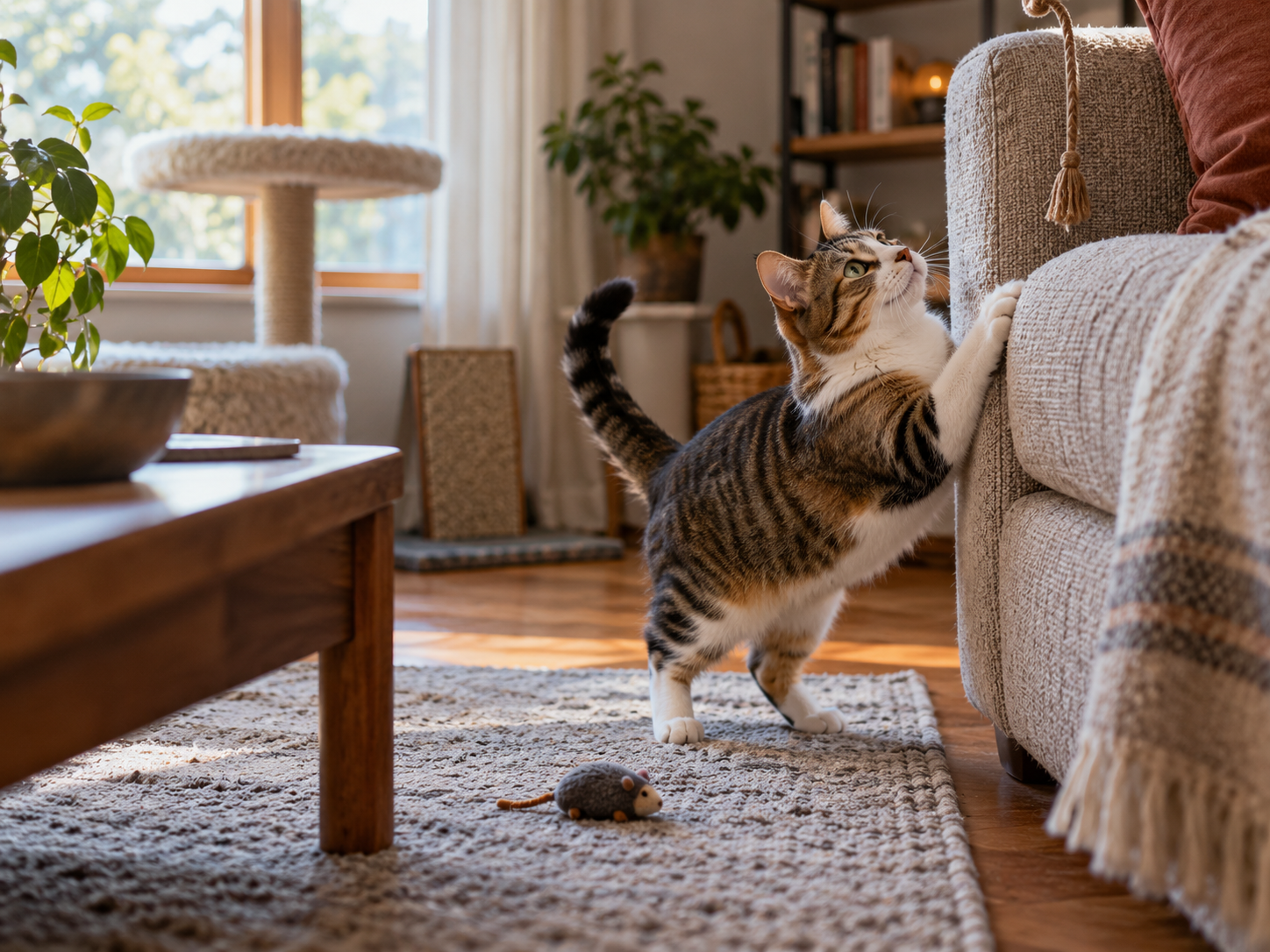
In the wild, felines spend a significant portion of their waking hours hunting, stalking, and patrolling territory. Indoor cats retain these exact same predatory drives, but apartment living often offers very little natural outlet for them. When cats do not have appropriate channels for physical and mental energy, they invent their own—often resulting in 3 AM sprinting sessions across the bed, shredded sofa arms, or chewed electrical cords Common signs of indoor cat boredom include nighttime zoomies, scratching furniture, and destructive chewing.
Traditional pet stores often market massive multi-tiered scratching trees and heavy plastic gadgets as the primary solution. However, these items frequently dominate small rooms, collect dust, and fail to engage a cat’s intellect over time. Feline enrichment is less about the sheer volume of purchased items and more about variety, novelty, and meeting core behavioral requirements across play, foraging, resting, and sensory exploration Indoor cats require varied environmental stimulation across play, food, resting perches, and sensory exploration to prevent boredom. By focusing on strategic home modifications rather than clutter, owners can satisfy their cats more effectively.
The Behavioral Cost of Monotony
When an apartment remains completely static, a cat’s environment ceases to provide mental engagement. Felines are naturally curious animals that investigate changes in their surroundings. Without new stimuli, cats may sleep excessively out of sheer listlessness or develop stress-related habits. Introducing variety does not require buying new products every week; rather, it involves rearranging existing elements and utilizing everyday materials to keep the environment dynamic.
Veterinary behaviorists emphasize that environmental enrichment acts as a primary buffer against stress. Cats that can express natural behaviors—such as scratching, climbing, foraging, and watching prey-like movement—show fewer behavioral problems. Owners can achieve this balance by dividing the living space into functional zones that address these instincts without encroaching on human comfort.
Maximizing Vertical Space Without Adding Floor Clutter
Cats are naturally arboreal animals that feel safer and more confident when they can observe their domain from an elevated vantage point. In smaller homes, adding floor-standing cat trees quickly crowds the room, but utilizing existing vertical architecture provides an elegant alternative.
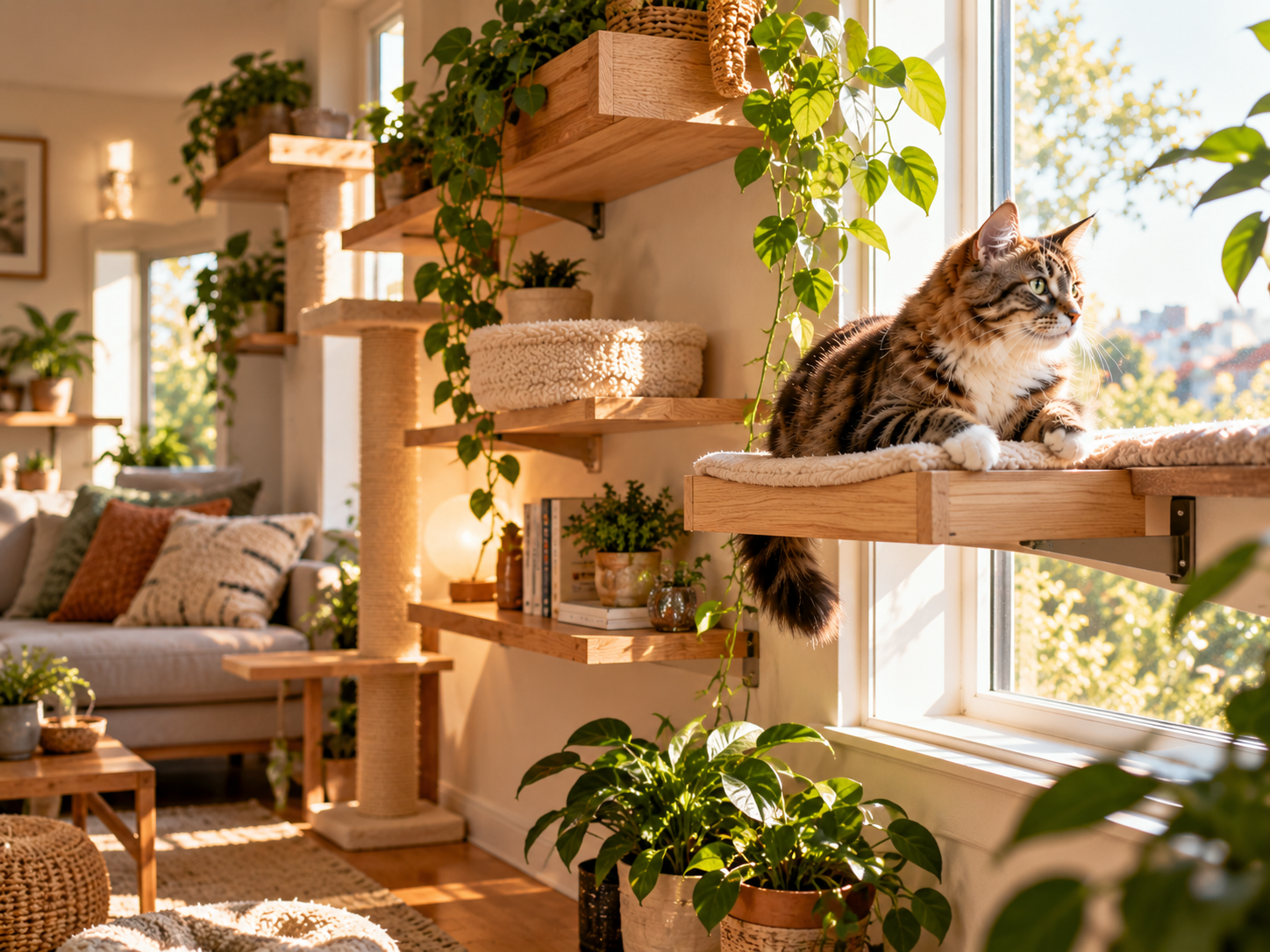
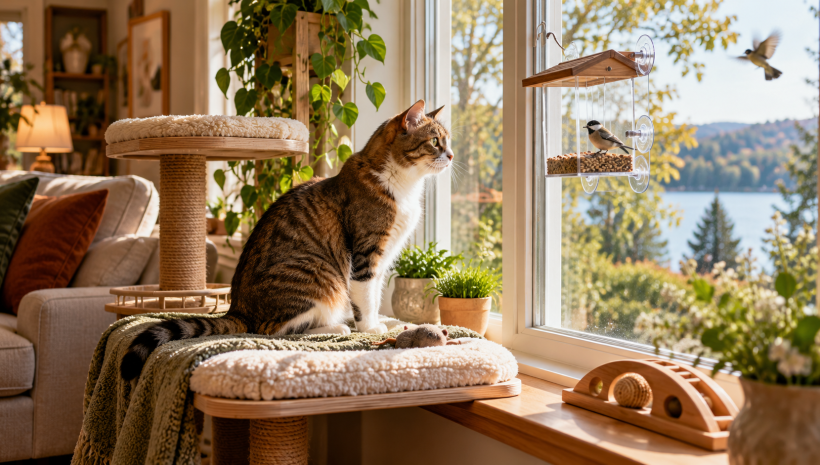
Owners can create vertical pathways by rearranging books on a shelf to leave an open resting step, installing sleek floating wall shelves designed to match room decor, or placing secure window perches that offer a view of the outdoors. These elevated spaces multiply a cat’s usable territory without taking up a single square foot of floor space Vertical space utilization, scent work, and toy rotation allow high-level enrichment in small apartments without cluttering rooms with bulky furniture. Combining these perches with a nearby vertical scratching post ensures that scratching, stretching, and climbing needs are fully met in an organized, minimalist manner.
Designing Safe and Accessible Climbing Routes
When designing vertical routes, stability is paramount. Wall-mounted shelves must be securely anchored into studs to support a cat leaping at full speed. Additionally, creating gradual steps rather than a single massive jump ensures that kittens, senior cats, or cats with lower mobility can still access their favorite viewpoints comfortably.
Positioning perches near windows provides dual benefits: elevation and entertainment. Watching birds, insects, and neighborhood movement outside satisfies a cat’s visual predatory drive. To optimize this setup, keep window sills clear of clutter so the cat has an unobstructed vantage point. For multi-cat households, creating interconnected vertical pathways also reduces territorial tension by allowing cats to pass each other without floor-level confrontations.
Foraging, Food Puzzles, and Mental Stimulation on a Budget
In a standard feeding bowl, an indoor cat consumes a daily meal in under two minutes, leaving the remaining hours devoid of predatory engagement. Modifying how cats access their food is one of the most effective ways to introduce mental stimulation without adding physical items to the home Indoor cats require varied environmental stimulation across play, food, resting perches, and sensory exploration to prevent boredom.
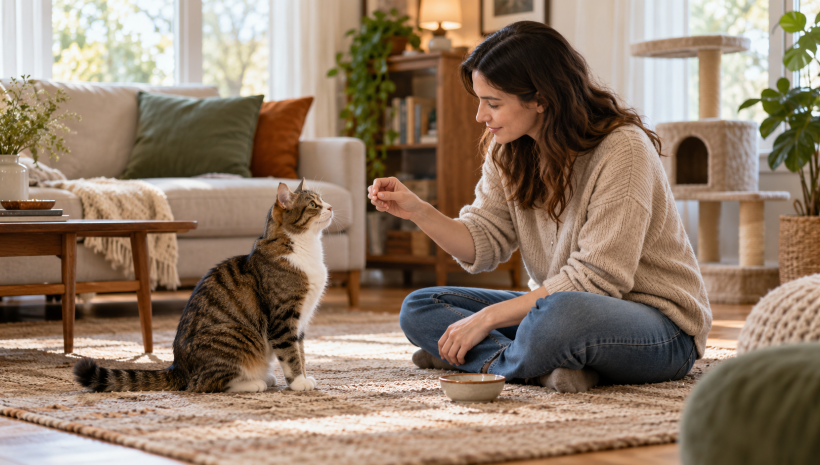
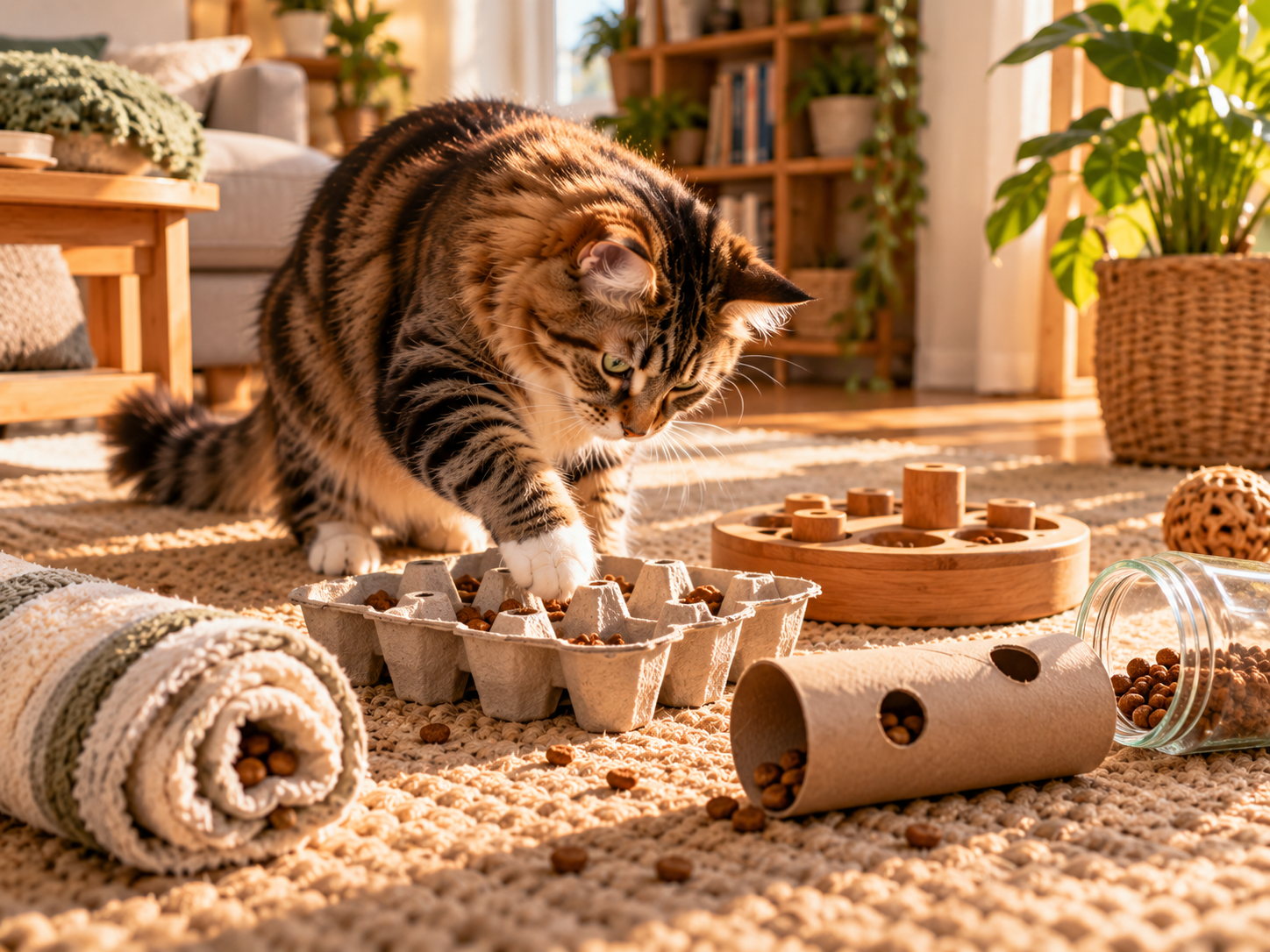
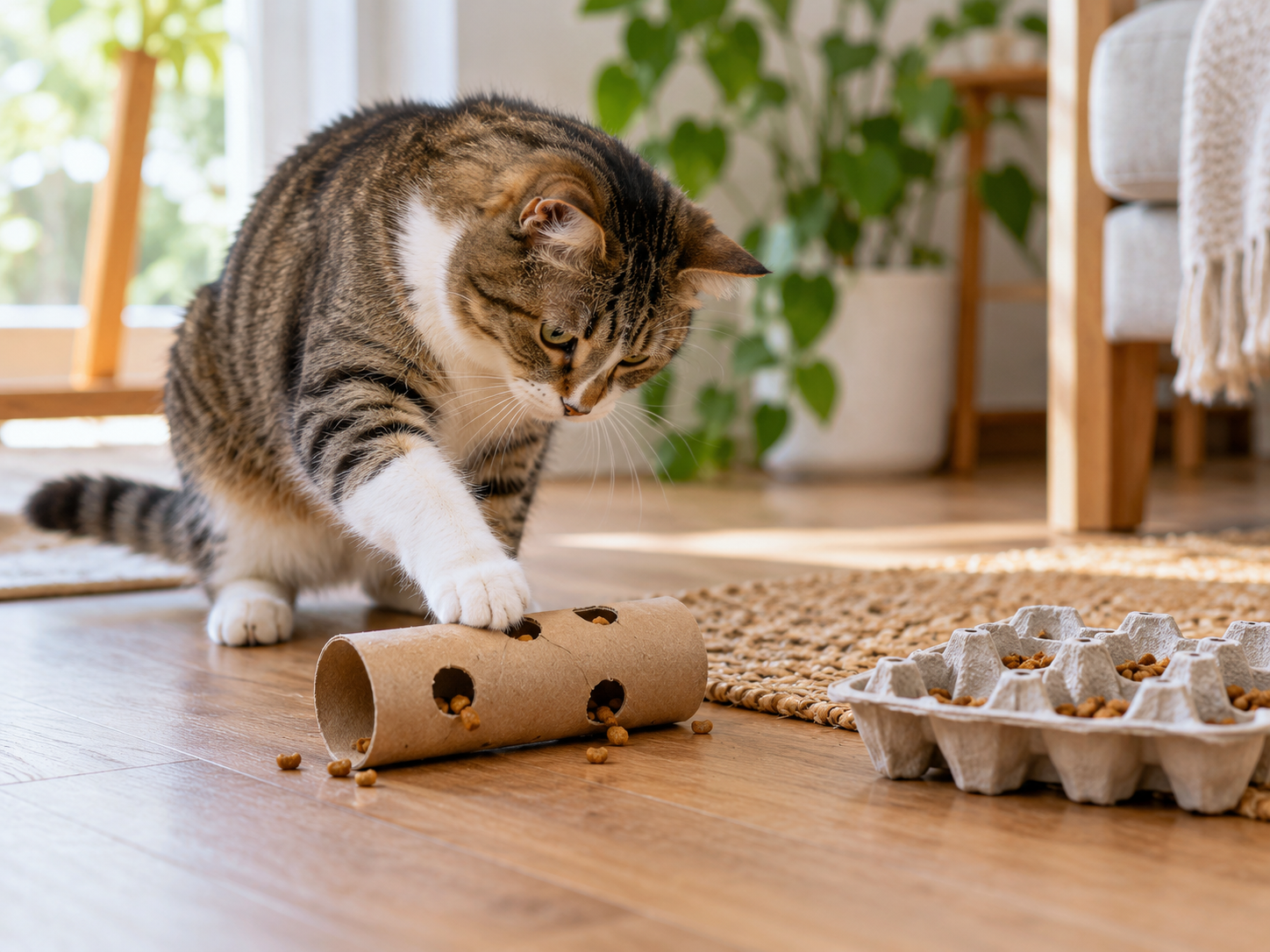
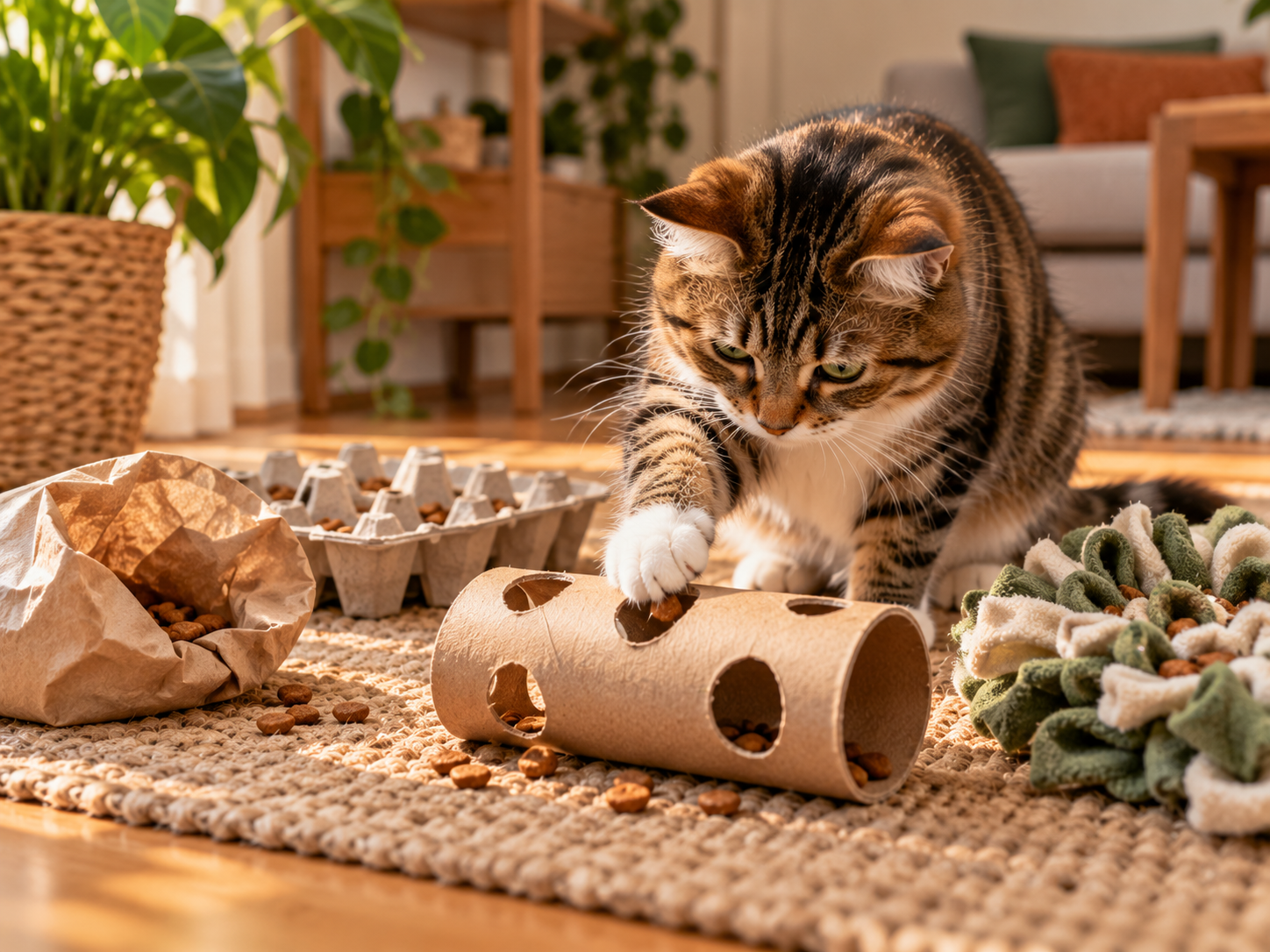
Simple household items make exceptional foraging tools. Empty egg cartons, cardboard boxes with small cutouts, and paper towel rolls can be transformed into DIY puzzle feeders that require cats to bat and paw for kibble. Scattering dry food across different heights or hiding small portions in various rooms encourages natural hunting behaviors. These feeding strategies slow down eating, provide rewarding mental challenges, and utilize items that would otherwise go into the recycling bin.
Practical Implementation of Food Puzzles
Transitioning an indoor cat to puzzle feeding should be gradual. Start with very simple configurations—such as a shallow box with kibble scattered loosely inside—so the cat easily understands the concept. Once the cat masters basic foraging, progress to more challenging setups like sealed cardboard tubes with small openings that require precise paw dexterity.
This approach transforms mealtime from a passive event into an active hunt. It burns mental energy, prevents the rapid eating that often leads to digestive upset, and keeps indoor cats engaged for significant portions of the day. Best of all, these cardboard creations can be recycled and replaced instantly whenever they wear out, maintaining a clean and clutter-free living space.
Scent Work, Toy Rotation, and Sensory Exploration
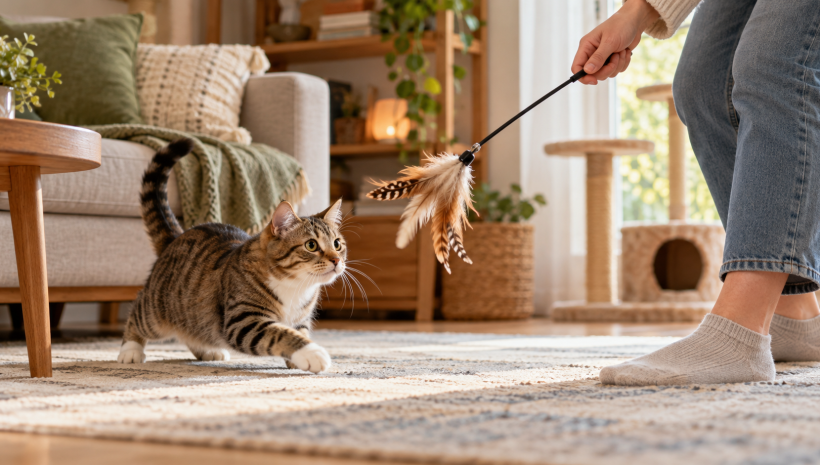
Physical toys lose their novelty quickly if left sitting on the floor day after day. A toy rotation system—where a basket of toys is kept out of sight and only three or four items are available at any given time, rotated weekly—keeps play sessions fresh and exciting Vertical space utilization, scent work, and toy rotation allow high-level enrichment in small apartments without cluttering rooms with bulky furniture.
In addition to toys, sensory exploration through safe scents can dramatically enrich an indoor environment. Introducing a small pinch of catnip, silver vine, or dried valerian root to a specific blanket, or letting a cat investigate supervised outdoor scents on a carried leaf or twig, stimulates olfactory processing. Because cats experience their world largely through scent, these subtle sensory additions provide profound mental enrichment without occupying any physical space in the home.
Maintaining Novelty and Olfactory Engagement
Scent-based enrichment taps directly into the feline brain’s primary sensory processing center. By regularly introducing new aromas or rotating scented items, owners stimulate curiosity without adding furniture or physical obstacles to the room. Similarly, the psychological impact of a rotated toy basket cannot be overstated; items that have been hidden away for weeks reappear as “new” prey, instantly reigniting hunting interest.
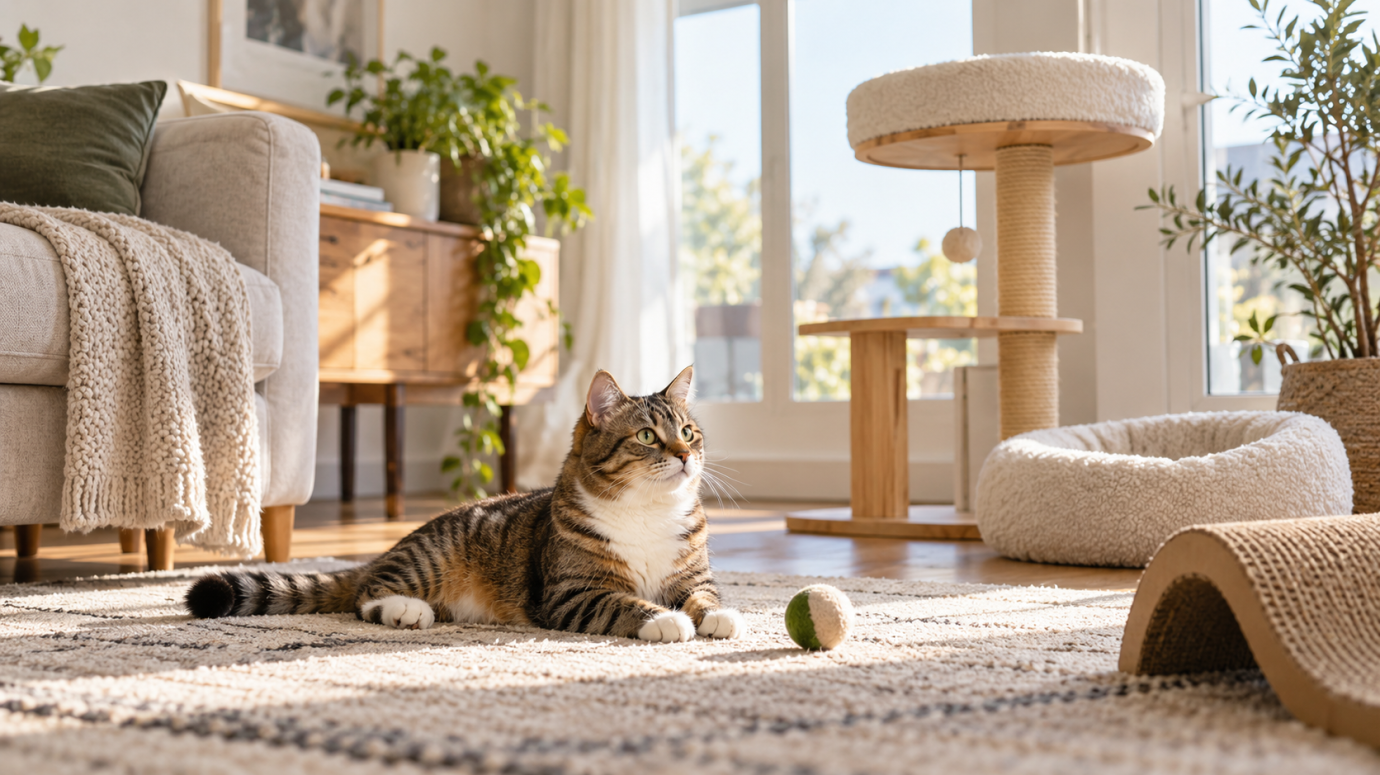
Ultimately, keeping an indoor cat mentally and physically stimulated in a compact home relies on strategy rather than accumulation. By leveraging vertical territory, transforming everyday recyclables into foraging challenges, and maintaining dynamic toy and scent rotations, owners can build a thriving, harmonious environment that satisfies feline instincts while preserving a clean, minimalist living space Vertical space utilization, scent work, and toy rotation allow high-level enrichment in small apartments without cluttering rooms with bulky furniture, Indoor cats require varied environmental stimulation across play, food, resting perches, and sensory exploration to prevent boredom.