

Balancing a demanding professional life with the needs of a companion animal can feel like walking a tightrope. For the reader and many other dedicated cat owners, the desire to provide a meaningful, enriched life for a feline companion often clashes with unpredictable work hours, family commitments, and daily stress. Yet, cats thrive on predictable daily structures such as consistent feeding times and regular interactive play Cats thrive on predictable daily structures such as consistent feeding times and regular interactive play. When human schedules fluctuate wildly, maintaining that stability requires a thoughtful approach that honors both human capacity and feline biology.
Understanding how cats experience time and routine helps demystify why consistency matters so much to them. Unlike humans, who easily parse changing calendar appointments, cats rely heavily on environmental cues and temporal patterns. Establishing a reliable rhythm reduces stress, prevents unwanted behaviors driven by boredom, and deepens the bond between you and your cat.
Understanding Feline Predictability in a Busy Life
Companion cats are creatures of habit who find comfort in predictability. In ancestral environments, predictable cycles of hunting, eating, grooming, and resting provided safety and survival. Domestic cats retain these deep-seated biological rhythms. Consistency and stable daily schedules help companion cats thrive Consistency and stable daily schedules help companion cats thrive. When feeding times, play sessions, and environmental interactions happen around expected windows, cats feel secure in their territory.

However, modern human life is rarely uniform. Overtime shifts, travel, and unexpected crises disrupt even the best intentions. When a human schedule becomes erratic, a cat may experience subtle anxiety, sometimes expressed through vocalization, pacing, or changes in elimination habits. The goal is not to create an unyielding, minute-by-minute timetable that shatters the moment you run ten minutes late. Instead, the objective is to build a resilient framework that absorbs minor schedule shifts while preserving the core predictable anchors your cat relies on.
Recognizing individual variation is equally important. Some cats adapt swiftly to shifting human routines, while others show profound sensitivity to minor changes in their environment. Observing your cat’s specific behavioral cues during schedule transitions will guide you in tailoring how much structure they personally require to remain calm and content.
Micro-Habits and Flexible Anchors for Time-Crunched Owners
When your schedule is packed, the traditional advice of spending hours curating complex enrichment activities can feel overwhelming and unsustainable. Routine building is hard when life gets busy or unpredictable Routine building is hard when life gets busy or unpredictable. Effective routines must work with real-world personality and time constraints rather than rigid ideals Effective routines must work with real-world personality and time constraints rather than rigid ideals. Busy owners succeed with routines by establishing flexible anchors and micro-habits rather than rigid, time-heavy schedules Busy owners succeed with routines by establishing flexible anchors and micro-habits rather than rigid, time-heavy schedules.

Consistent triggers, anchors, and simplified repeatable systems keep days humming along when time and attention are fragmented Consistent triggers, anchors, and simplified repeatable systems keep days humming along when time and attention are fragmented. Instead of setting a strict alarm for a 30-minute play block that you will inevitably miss on heavy workdays, attach micro-habits to existing daily anchors. For example, use the time while your morning coffee brews to engage your cat with a brief, high-intensity wand toy session, or scatter a small portion of dry food in a puzzle feeder right as you log into your computer for the workday.
Successful routines do not mean spending hours on complex plans; they must match available time and prioritize long-term consistency over unrealistic demands Successful routines do not mean spending hours on complex plans; they must match available time and prioritize long-term consistency over unrealistic demands. By anchoring feline care to immutable daily human habits—such as waking up, brushing your teeth, or returning home from work—you create reliable touchpoints that your cat learns to anticipate. Even if the exact hour shifts slightly from Tuesday to Wednesday, the sequence remains recognizable and reassuring.
Low-Time Enrichment and Independent Play Strategies
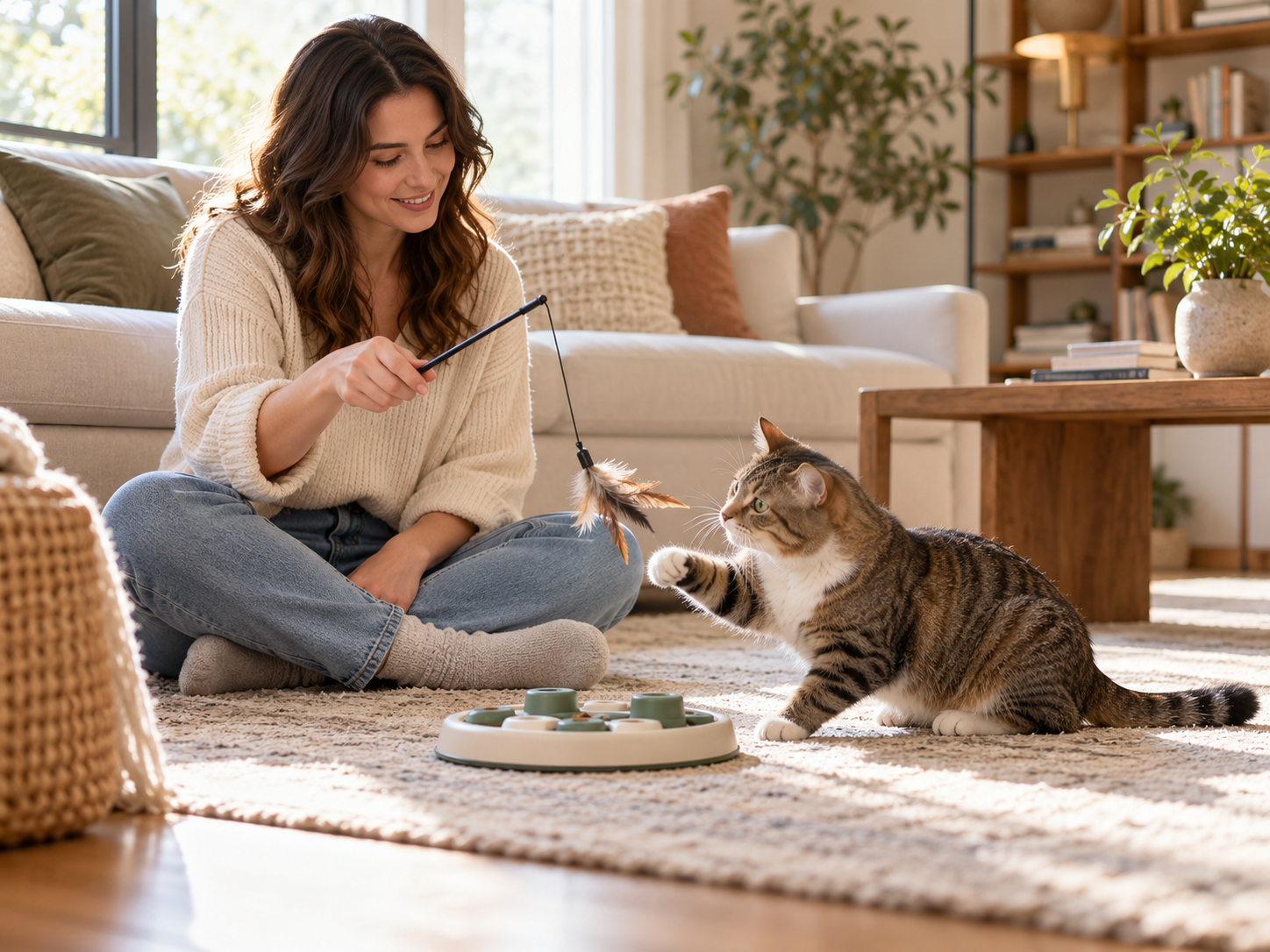
When you are genuinely short on time, active engagement can be supplemented intelligently with environmental design. Daily enrichment like wand play, puzzle feeders, and consistent routines channel clever feline energy into healthy habits Daily enrichment like wand play, puzzle feeders, and consistent routines channel clever feline energy into healthy habits. These tools allow your cat to express natural predatory instincts without requiring your undivided attention every single minute.

For instance, puzzle feeders and treat-dispensing balls transform a routine meal into an engaging foraging puzzle that occupies your cat independently while you take an urgent work call or prepare dinner. Rotate a small selection of toys weekly so that old items regain novelty, preventing boredom without requiring you to purchase new items constantly. Vertical space, such as a secure windowsill perch or a cat tree positioned near a bird-watching window, provides passive visual enrichment that satisfies a cat’s curiosity throughout the day.
When you do have five or ten minutes of free time, make it count. Brief, focused interactive play sessions—where your cat gets to stalk, chase, and successfully capture a toy—satisfy the complete predatory cycle far better than hours of unstructured, unattended toy access. Quality and predictability outweigh sheer quantity when maintaining a harmonious routine in a busy household.
Frequently Asked Questions
How can I maintain a consistent routine for my cat when my work schedule changes daily?
Focus on anchor events rather than exact clock times. Feed your cat or initiate a brief play session around fixed lifestyle markers, such as immediately waking up or walking through the door after work, rather than a rigid hour. Cats adapt well to sequential routines even when the absolute timestamp varies.
What are some quick ways to provide daily enrichment if I am short on time?
Utilize puzzle feeders for meals, scatter dry kibble across a safe surface for foraging, or place a sturdy bird feeder outside a secure window to provide passive visual stimulation. These require minimal active effort from you while keeping your cat mentally stimulated.

Do cats really need structured feeding and play times to stay healthy?
Yes, structured routines help regulate a cat’s internal biological clock and reduce stress-related behaviors. Predictable feeding and play sessions give cats a sense of control over their environment, which is vital for their emotional well-being.
Conclusion
Building a cat-friendly daily routine amidst a busy lifestyle does not require perfection or endless free time. By understanding your cat’s need for predictability, anchoring micro-habits to your existing daily schedule, and leveraging efficient independent enrichment tools, you can cultivate a balanced environment where both you and your feline companion thrive.